History

Kept in song.

For most of their past the Kam wrote nothing down. Scroll to unroll their country.

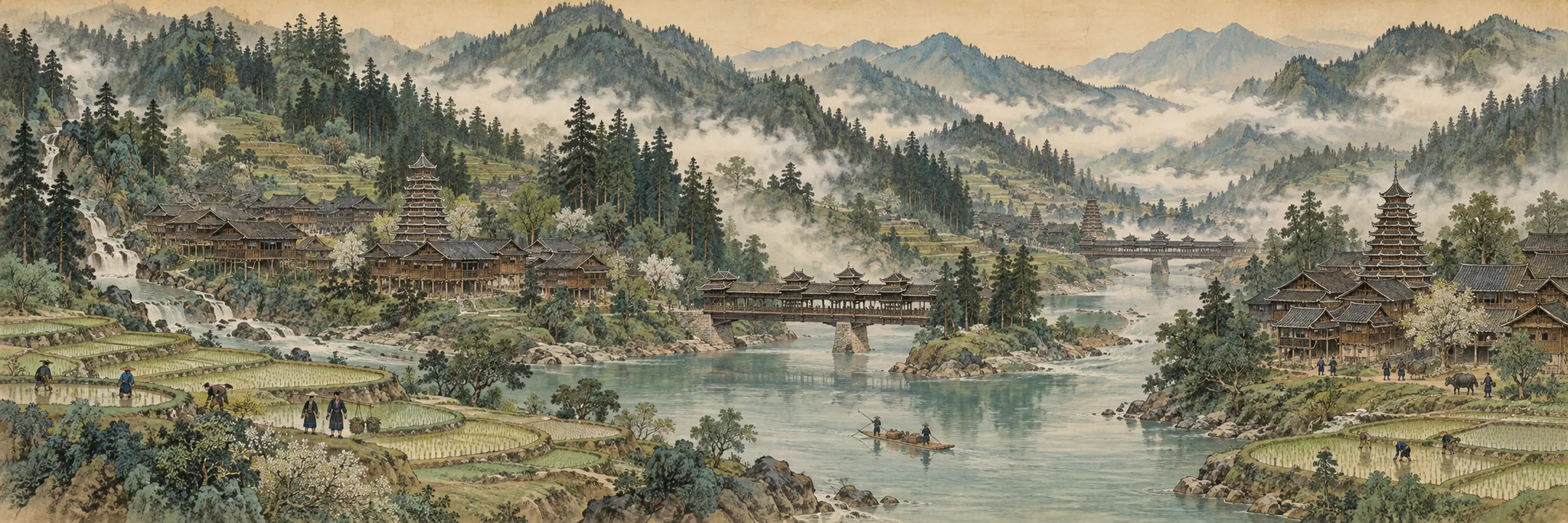
Ink-and-colour painting of a river valley with Kam villages, drum towers, covered bridges and rice terraces

The ridgesFir forest — the timber of every tower, bridge and house.

The villageHouses crowd around the drum tower, the village’s meeting hall.

The riverWind-and-rain bridges join the banks and shelter travellers.

The slopesTerraces of sticky rice, with fish and ducks in the water.

The Kam had no script of their own until 1958. Their history lived in the Grand Song and in the kuan codes recited by elders. What we know from paper comes mostly from outsiders — imperial officials, travellers and, later, scholars.

Antiquity

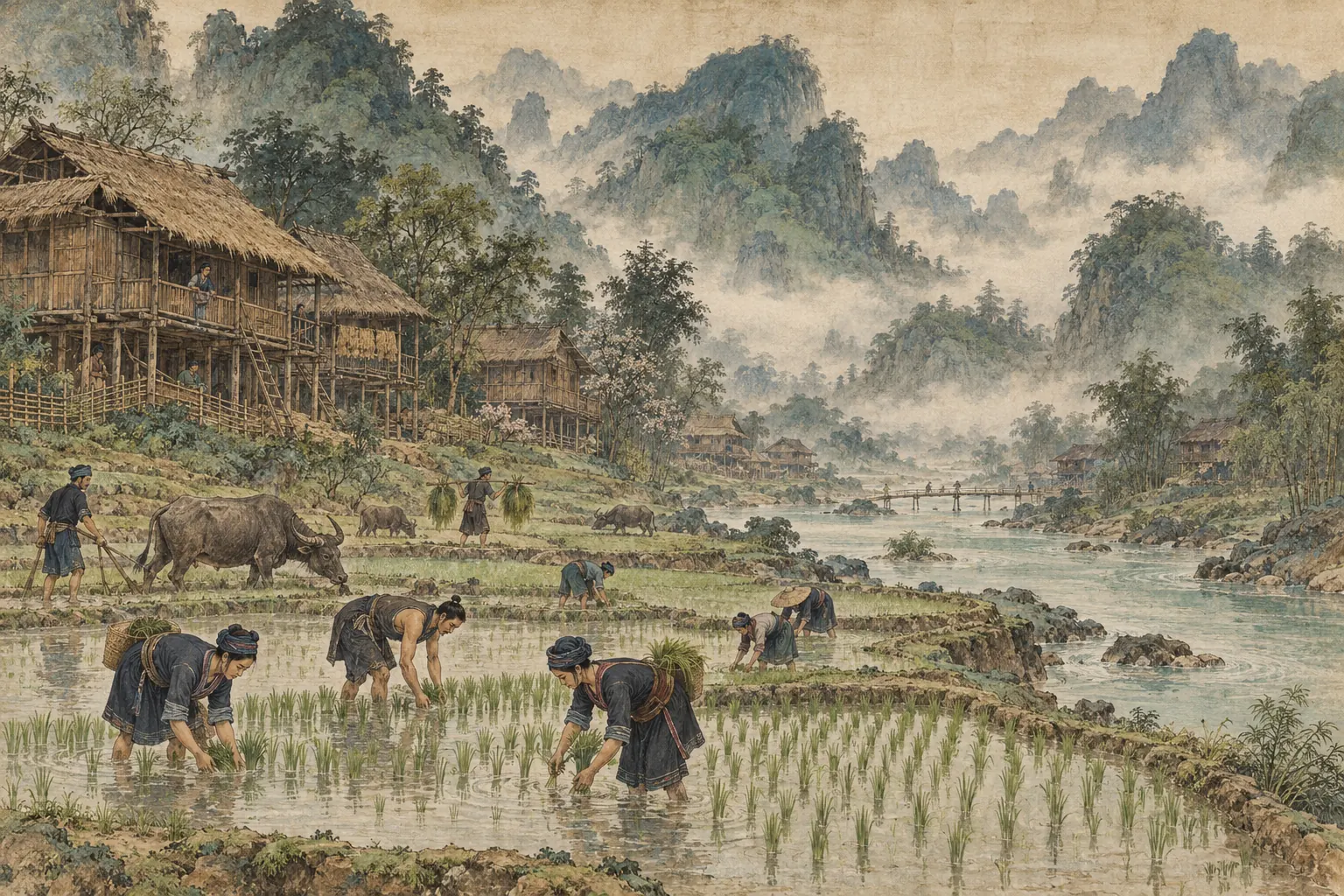
Ink painting of ancient rice farmers in a misty river valley

Roots

Rice farmers of the south.

Kam belongs to the Kam–Sui branch of the Kra–Dai languages, a cousin of Sui, Maonan and Mulao. Historians commonly link the Kam to the ancient Baiyue — the “Hundred Yue” peoples who farmed wet rice in the river valleys of southern China — though they disagree on which branch.
1100s

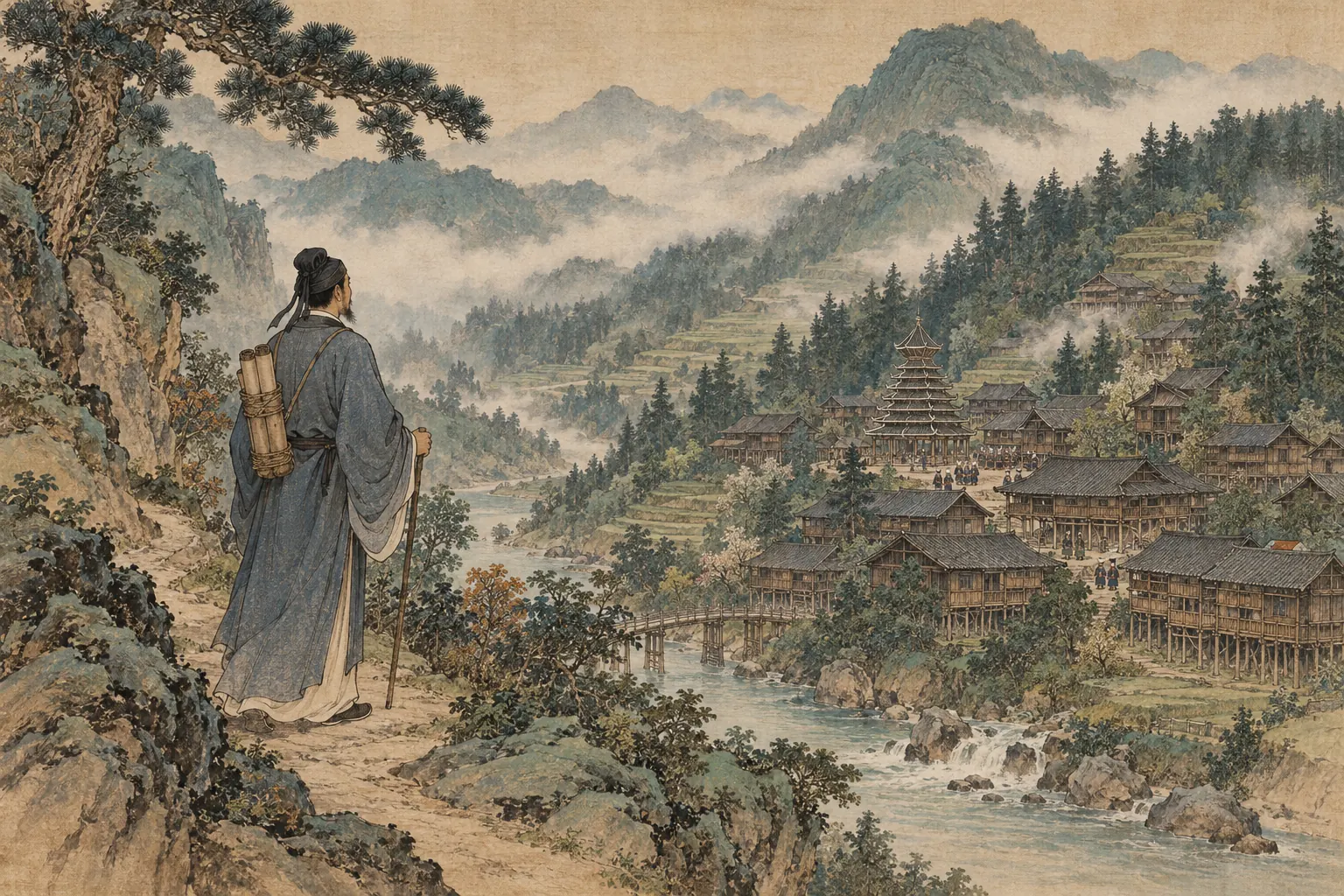
Ink painting of a Song-dynasty traveller looking across a valley at a mountain village

Song dynasty

A name on paper.

The Song poet Lu You listed the Geling 仡伶 among the hill peoples of western Hunan — “the strongest of them, practised in war”. Many historians see them as ancestors of the Kam; names closer to “Dong” appear in Ming records.

For centuries

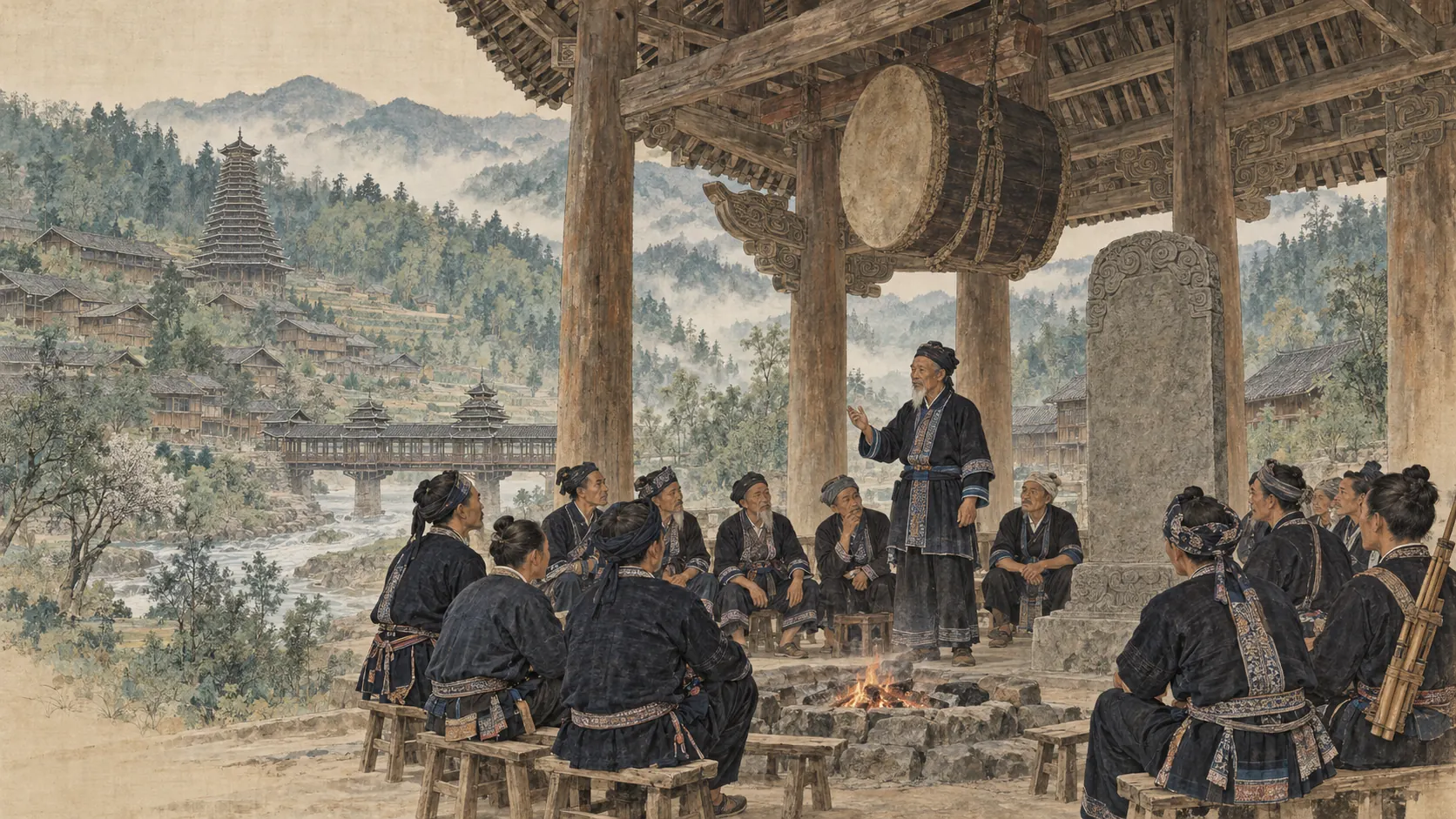
Ink painting of villagers gathered around a drum-tower fire while an elder recites beside a standing stone

The kuan

Law by heart.

Kam villages governed themselves through kuan — alliances of neighbouring villages, nested into larger leagues across whole valleys. Elders gathered the villages, agreed the kuan codes and proclaimed them aloud; an assembly could be sealed by planting a stone upright in the ground — “burying the stone”.

1368–1912

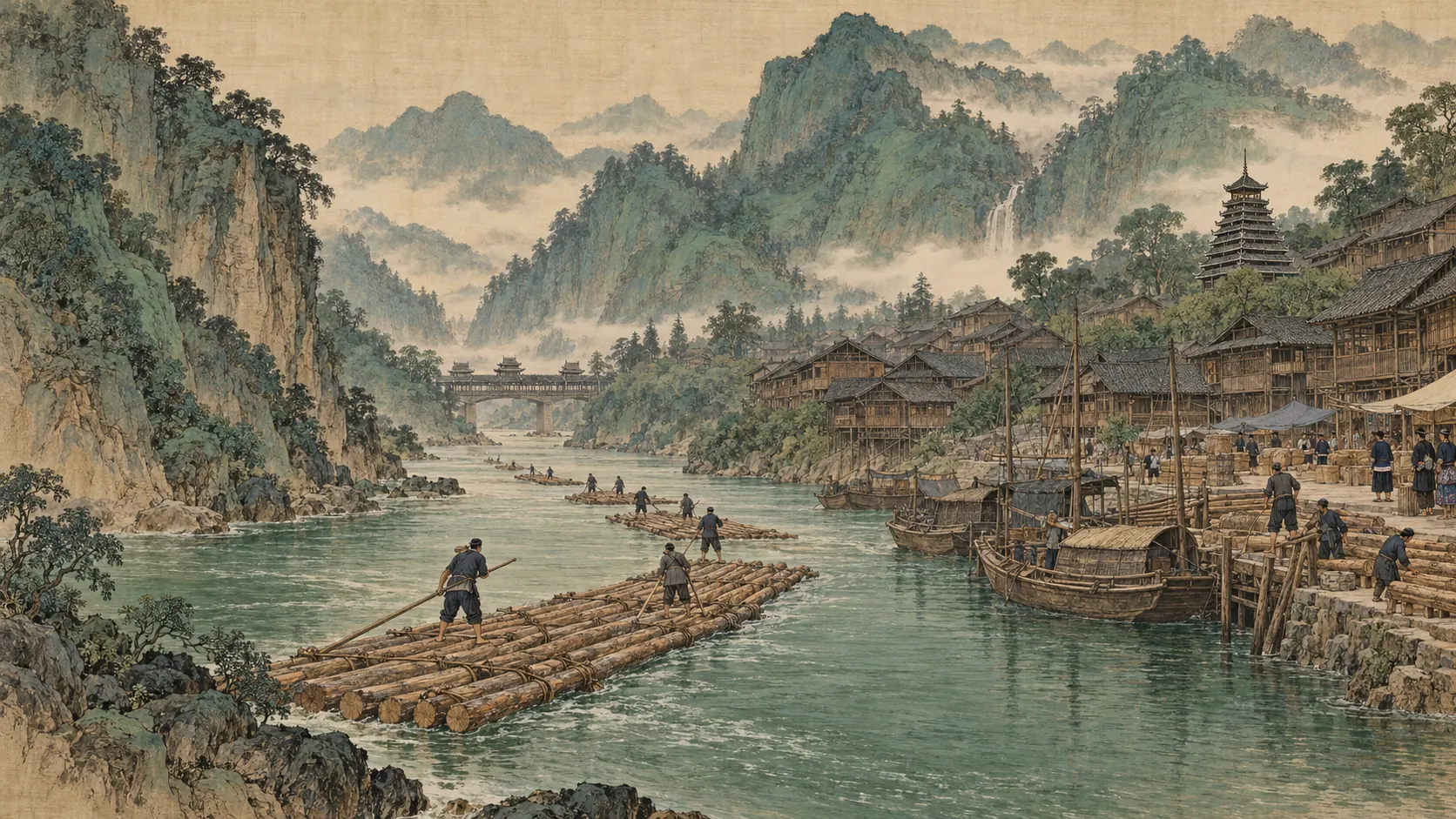
Ink painting of fir-log rafts floating down a river gorge to a market town

Ming and Qing

Empire, and timber.

In 1413 the Ming created Guizhou province, with a prefecture at Liping, while local chieftains went on ruling many Kam areas for the court. In the 1720s and 1730s Qing military campaigns brought the Qingshui River region under direct rule.

Fir from Kam and Miao forests was rafted downstream to distant markets, and families recorded each sale and lease of forest land in contracts — the Qingshui River documents. Tens of thousands survive.

1855

Uprising

Jiang Yingfang rises.

Amid the unrest that swept Guizhou in the mid-19th century, Jiang Yingfang, a Kam from Tianzhu, led an uprising in 1855. He was executed in 1862; his followers fought on until 1868.

1934

The Long March

An army passes through.

In December 1934 the Red Army’s Long March crossed Kam country. Meetings held in Tongdao and Liping changed the direction of its march.

1950s

Recognition

Named, mapped, written.

In the early 1950s the Dong were recognised as one of China’s nationalities. Sanjiang became the first Dong autonomous area in 1952, followed by Tongdao in 1954 and the Qiandongnan Miao and Dong Autonomous Prefecture in 1956. In 1958 linguists created a Latin alphabet for Kam, based on the speech of Rongjiang.

1986

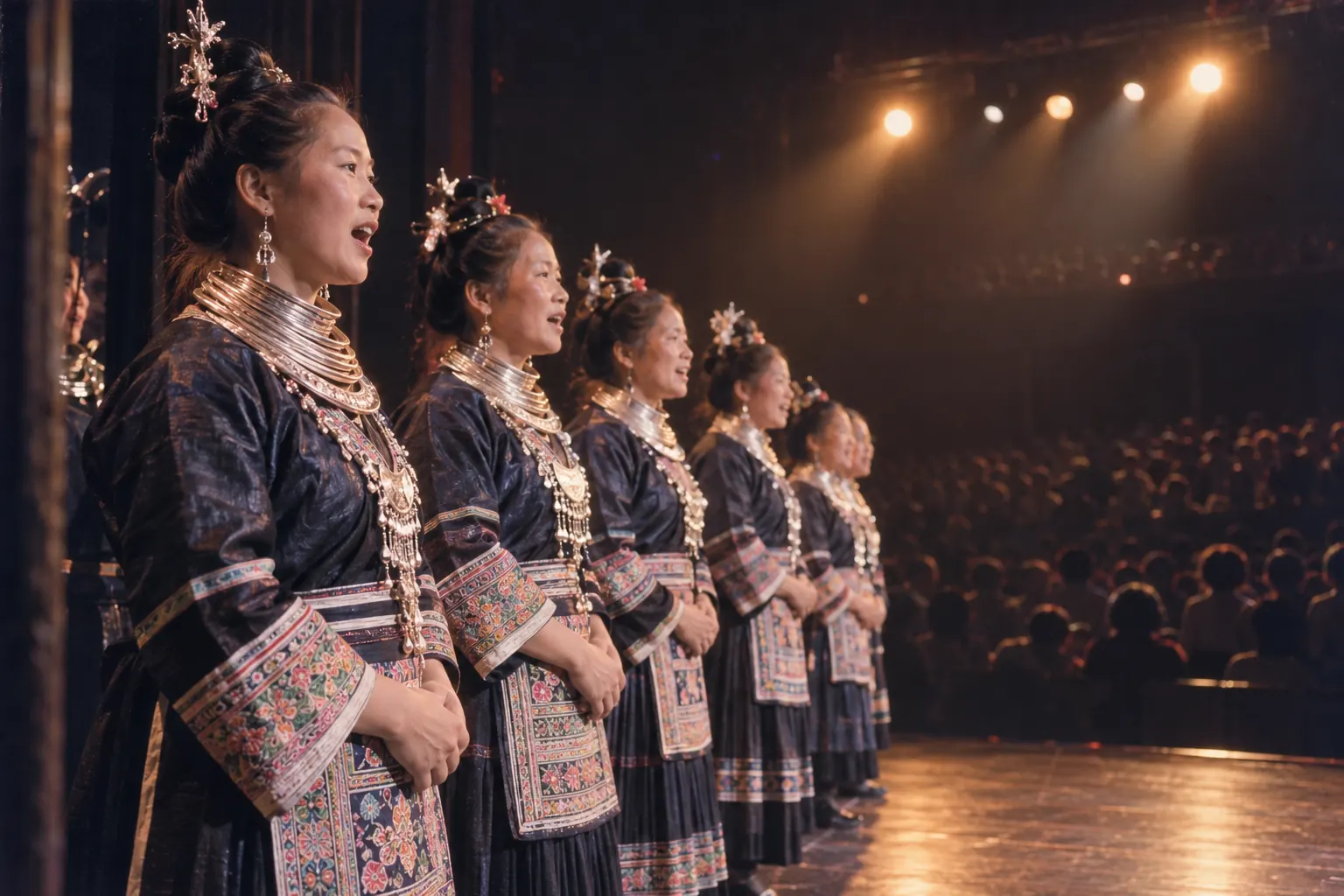
A choir of Kam women singing on a theatre stage under warm spotlights

Paris

The world hears the Grand Song.

Eight young Kam women from Guizhou sang at the Festival d’Automne in Paris, in a season devoted to China. Their unaccompanied polyphony drew wide attention, and the Grand Song began to be heard far beyond the mountains.

Today

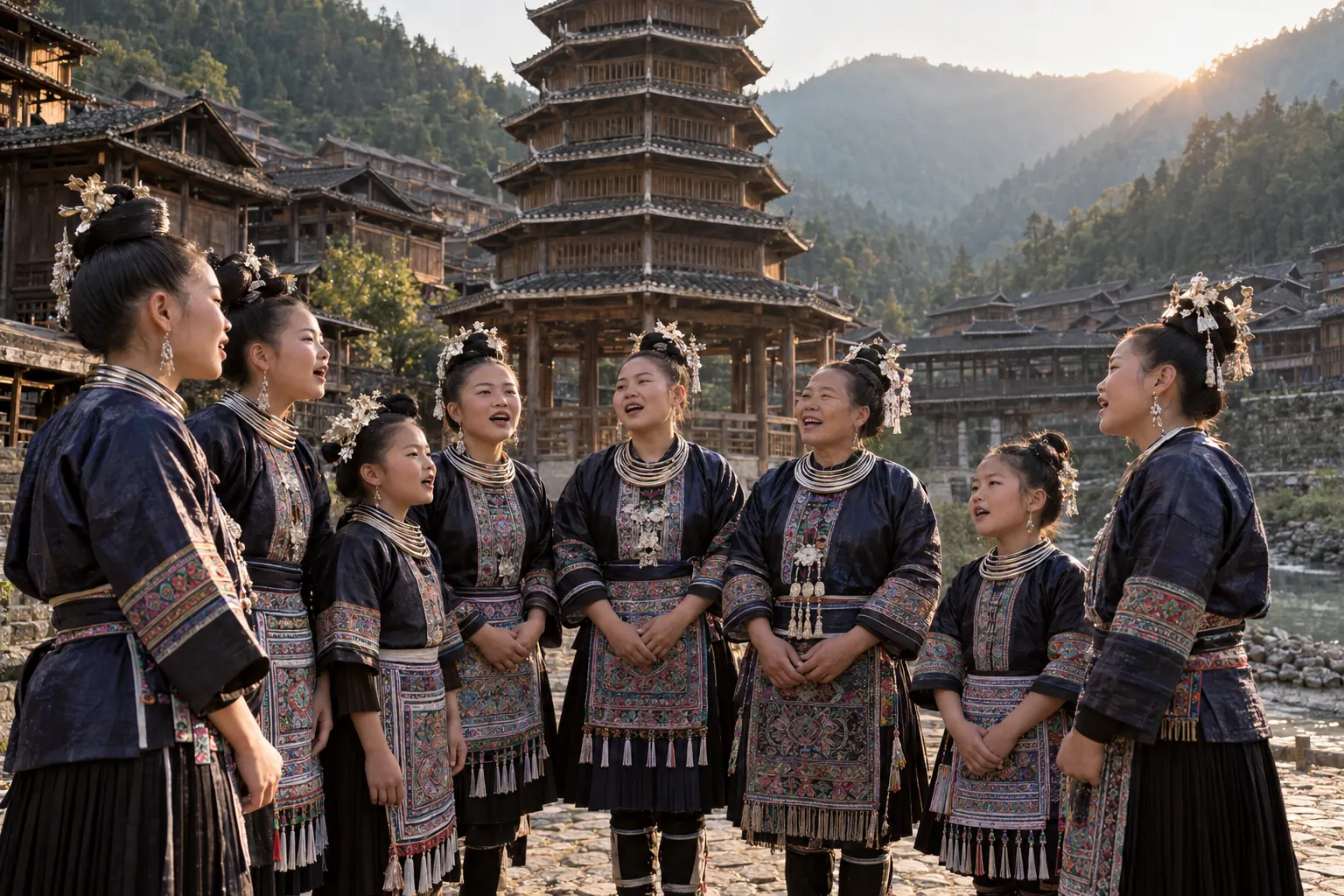
Kam women in festival dress singing in front of a drum tower

2009 and after

Heritage, and change.

UNESCO inscribed the Grand Song in 2009 and FAO recognised Congjiang’s rice-fish-duck fields in 2011. In 2012, 25 Kam villages joined China’s tentative list for World Heritage, and Kam timber building, brocade, opera and festivals are protected as national intangible heritage.

Many young Kam now work in the cities of Guangdong and Zhejiang, while villages balance tourism with daily life — and choirs still practise in the drum towers.

Keep exploring

Meet the Kam today.